

How To Repair Collimation Errors
#1 
Posted 10 December 2018 - 03:53 PM
I have recently tested well-nigh ten binoculars in the price range under 140$ with 8x-10x magnification and 40-50 mm aperture (full report will come up before long). Vertical collimation was good on all of them. Nonetheless, I was surprised by how many of them had large horizontal collimation errors:
- six of them had horizontal errors between 2° and 3°.
- 1 of them had a horizontal error of 1.3° (convergent)
- three of them had an errors of 0.6° or less.
Is this normal? What is an acceptable limit (in this cost range) for collimation errors on binoculars that will be used for night sky observations? I know this may vary between individuals, merely I am looking for a limit that would be adequate for, say sixty to fourscore % of all observers.
What I believe to know
In general, big collimation errors will cause issues for the brain with assembling the epitome correctly. When the collimation error is moderate and the observed subject contains many clear details and patterns, our brain's center of vision volition usually be able to assemble the immage correctly. However, many astronomical objects and star fields contain relatively few details, and I therefore wait the tollerable level of collimation errors to be smaller for astro use than for nearly other uses.
Collimation errors may also cause physical strain to the eyes, since they are not used to being pointed in two different directions
I made a search on the forum and plant the following posts past EdZ's, refering to a book past J. W. Seyfried, run across https://world wide web.cloudyni...ted/#entry68300. When converting the limts given by EdZ into credible angles (those seen in the eyepieces) I get the approximate limits listed below:
- Maximum 0.6° vertical error (one eye upwardly, the other down)
- Maximum one.4° horizontal convergence (eyes crossed over)
- Maximum 0.9° horizontal difference (eyes spread autonomously)
Nonetheless, EdZ besides writes that he himself tin can inappreciably tolerate one half of the errors higher up. Also, I suspect that the tollerance is lower when whatching a sparse star field so when whatching daytime objects with lots of articulate patterns.
An easy manner to measure binocular collimation errors
Collimation error for a binocular ways that the direction towards the prototype appears different for the left and the right heart. This is illustrated in effigy a) below, where the image seen past the left and the right eye are shown in cherry-red and cyan, respectively.

Collimation errors should not be dislocated with deviating fields of view, which is illustrated in figure b). In this case the objects in the image appear in the same direction for both eyes, so they are easilly combined into 1 single paradigm by the brain. The non-overlapping areas on each side contribute to a wider field of view, which is fine, allthough we have only one-eyed sight to these regions. A horizontal deviation in FOV of 5-10 % of the field diameter is non uncommon, and will ordinarily not cause problems for the observer.
Figures c) and d) above illustrate how the collimation can exist tested. The binoculars should be placed on a stand or on a steady surface where their management can be adjusted while looking through them. Indicate the binoculars towards a conspicuously visible horizontal or vertical line at least thirty grand away. The top or side of a large house may be suitable.
Now move your eyes 30 to l cm behind the eyepieces and locate the line through 1 of them. (Here, you may need to arrange focus to run across a well defined go out educatee). Fine adjust the direction of the binocular until the observed line is alligned inside and outside the eyepiece, as illustrated in figure c) and (roughly) for the right eyepiece in figure d).
Now, wait through the other eyepiece. If the line is not alligned inside and exterior this eyepiece, then in that location is a collimation error in the direction perpendicular to the line. The magnitude of the mistake equals the apparent angle between the inside and outside line segments. This bending tin be found by measuring the apparent separation of the lines with a ruler that is placed 57 cm from your eyes. At this altitude, 10 mm on the ruler spans an angle of one°.
The example in the effigy shows a perfect vertical collimation, while the horizontal collimation deviates by ii°.
Erlend
Edited by ronnekex, xi December 2018 - 03:52 PM.
- djeber2, Stellarfire and Nate1701 similar this
#ii
Posted ten December 2018 - 04:01 PM
My rule of thumb was ever if my head hurt looking thru them they were likewise far out. So I merely buy ones I tin examination or summit brands. I remember I accept 5 pairs requite or accept one. All are either Vixen, Pentax, or Nikon (one older height Celestron version, the 10x42 Nobles). Non that they are the all-time or the only ones. It only worked out that fashion. I worked for a Celestron/Meade/Pentax/Zeiss dealer for a time and so I got to compare them a lot. I likewise got to see a proficient number of used bad ones. If they were worth it nosotros sent them to a specialist (retired or passed away at present) and got them recollimated. Never tried fixing them myself although I did everything else.
Edited by photoracer18, 10 December 2018 - 04:03 PM.
#3
Posted 10 December 2018 - 05:57 PM
Some of the literature allows upwards to 2.7 deg horizontal mismatch (nearly entirely convergent)... Almost makes me call up some shops intentionally bias their builds on the convergent side... by a Lot?! Just truly-comfortable numbers are more like iii.4 arc-min vertical, 3.4 horizontal divergent, 8.6 arc-min convergent. I'k (admittedly) guessing that in that low price range, maybe they are edifice them to the loosest tolerances establish in the literature? Yous are using an instrument that does not depend upon the user's own fusion judgment? Some instruments get effectually that upshot, with creative educatee-sharing displays, etc.
Ummm... Yous are using a Collimator, correct? I'k non trying to be a jerk; merely worked at B&L, back where they were still a true optics company. They, of grade, had walk-upwardly collimators, seemed all over the place.
A biggish telescope, with a reticule at focus, makes a Great collimator! Tom
#four
Posted 10 December 2018 - 06:10 PM
Skilful post, Erlend. Collimation is something nosotros hear a lot about in the Binoculars forum; sadly, perhaps more than nosotros should. Some binoculars are infamous because of their reputation for poor collimation.
Regarding the standards from EdZ yous posted:
I made a search on the forum and plant the following posts by EdZ's, refering to a book by J. Westward. Seyfried, run into https://www.cloudyni...ted/#entry68300. When converting the limts given by EdZ apparent angles (those seen in the eyepieces) I get the approximate limits listed below:
Maximum 0.half-dozen° vertical error (one centre up, the other down)
Maximum 1.4° horizontal convergence (eyes crossed over)
Maximum 0.ix° horizontal divergence (eyes spread apart)Nonetheless, EdZ also writes that he himself can inappreciably tolerate one half of the errors above. Also, I suspect that the tollerance is lower when whatching a thin star field and then when whatching daytime objects with lots of clear patterns.
In a 2005 thread, forum member Claudio posted his revised collimation standards that may be more appropriate than the above standards:
The tolerated apparent alignment errors (= referred to paradigm infinite, i.e. the images seen through the eyepieces, i.due east. magnified by the binocular under test) I accept more often found are:
Vertical pace: 15 arc minutes
Divergence: 20 arc minutes
Convergence: 60 arc minutesSimply Nib, Cory and anyone who overhauls seriously binoculars would stay well within these limits. "Tolerances are for those who can't get it right", isn't that so, Nib?
A reason more than to adopt apparent alignment errors, i.e. information referred to the epitome infinite: they are what the middle see through the eyepieces, so they indicate (or SHOULD Signal, merely allow me say again that they are likewise permissive) the threshold that says what eyes sense. So, in your 16x the axes footstep of 3' doesn't requite me an firsthand, graphic idea of how much the misalignment is detected by optics, on the contrary the resultant credible step (= the step detected on the image space = 3' x 16 = 48') make me instantly think that your glass would benefit a lot from an overhaul of Pecker or Cory. That vertical step at 100 one thousand is nearly ix cm, negligible at most for a 5x, just not for a 16x.
The information reported by Seyfried are too "tolerant". Moreover,they give the same maximum axes errors for too wide ranges of magnification. For instance, in those tables a 5x and a 10x can have the aforementioned allowed axes errors, which cannot be.
Some other point made by Claudio explains why some standards for difference and convergence have values that announced reversed compared to others:
When nosotros discover tolerance data and they allow a greater error in departure, certainly those information are referred to the axes.
When tolerance data allow a greater mistake in convergence, they are certainly referred to the images seen through the eyepieces.
Example: let'south imagine that our binocular is not collimated. When pointed to a far electricity tower, this target is in the center of view for the left heart, while for the correct middle it is on the aforementioned plane (no vertical step) simply right from the eye. We are used to say that in that location is some divergence, which is correct when referred to the target. If we desire to be more than exhaustive, we have to say " images diverge, thus axes converge".
The same for the vertical step. For instance, if we observe a lower image through the right eyepiece, so it ways that the right centrality points higher than the left one.
Some texts express tolerances referred to the images, others to the axes. Equally explained, only by observing which is the wider tolerance between convergence and divergence we can empathize what they are referred to.
Food for thought, anyhow...
Rich
- Jon Isaacs, Mark9473, ronnekex and 2 others like this
#5
Posted 10 December 2018 - 08:59 PM
Another chemical element that I volition e'er accept to deal with (and I'm certain others will too...) is that my eyes are poorly aligned to begin with. And then I accept a much greater tolerance in ane direction, and much less tolerance in the other. 
- Jon Isaacs, Philip Levine, MeridianStarGazer and 1 other like this
#6
Posted 10 December 2018 - 09:39 PM
- Philip Levine likes this
#7
Posted x December 2018 - 09:52 PM
Another chemical element that I will e'er have to bargain with (and I'k sure others volition too...) is that my eyes are poorly aligned to begin with. And so I accept a much greater tolerance in one direction, and much less tolerance in the other.
Great bespeak! We all accept some personal "prism"... every bit the heart doctors call it. And THAT eats up some of our abailable margin! I have exactly one bino that allows "on the wing" aligning of the vertical and horizonal... The result is Amazing Comfort! Those extra adjustments take some getting used to, but essential when using binos at 200X.
#8
Posted 11 December 2018 - 10:16 AM
-------------------
"six of them had horizontal errors between 2° and iii°."
--------------------
Something doesn't seem correct.
First, to analyze: 2-3 degrees out the barrel, or in the view?
I recall I take merely seen one showroom binocular out of dozens
that had disturbing alignment.
I become the IPD distance settled in very well,
and then expect at a afar object with the eyepieces iii-4 inches from my eyes.
That easily multiplies the error while narrowing the view.
Anything that is minor or non-existent that way is incommunicable to discover
with the eyes right up to the eyepieces.
Setting the IPD wrong often causes trouble.
- Philip Levine and MeridianStarGazer like this
#9
Posted 11 December 2018 - 11:41 AM
-------------------
"6 of them had horizontal errors between two° and 3°."
--------------------
Something doesn't seem right.
Outset, to clarify: ii-3 degrees out the barrel, or in the view?
I read the OP'southward statement as saying he had converted EdZ's athwart tolerances that were originally listed in arc minutes to what was seen in the eyepieces's magnified (apparent) epitome space. And so his ii° error in the image space at 10x, let'due south say, would be a 12' angular mistake betwixt the bino's axes. Still way out from the Agency of Naval Personnel's 1966 standards of the time.
Rich
- Jon Isaacs and ronnekex like this
#10
Posted eleven December 2018 - 02:48 PM
--------------------
And so his 2° mistake in the epitome space at 10x, allow's say, would be a 12' angular mistake between the bino's axes. Still way out from the Bureau of Naval Personnel's 1966 standards of the time.
--------------------
OK...that's a bit more realistic.
So, for instance, out of a 60 degree view, two degrees.
Or..... 3.3% of the field.
I seem to remember Neb Melt saying the Naval Standard
was very small and the Russian Std. was more like what people tolerate.
If I were setting a US Navy standard for re-collimating
binoculars leaving a repair facility, I suppose that would exist possible,
one time yous hooked everything up and tweeked to the standard.
I tried some 8x30s, 7x35s, and 10x50s from 1950----1980 Nippon
Once the IPD is ready, I can't get the paradigm to suspension upwards, even
a whopping 6 inches from my optics.
I have moderately-priced Carson 8x32s ...made in China. Very squeamish, in use.
I can get an image separate at 3 inches from the eyes.
Scaling the 'stagger distance' to the view, seems like they are actually about
2% of the field off..... virtually 0.17 degrees. Not irritating, that I tin can tell.
Non certain if alignment is harder for roofs, or if China assembly is looser.
I'm still an order of magnitude from the above, though..
Edited past MartinPond, 11 December 2018 - 02:49 PM.
#eleven
Posted xi December 2018 - 02:57 PM
Of form, if you are looking at trees nearby,
as in an illustration above, you should look a deviation...
If your eyes are 3 inches apart, and the trees are 100ft away,
that'due south : 0.14 degrees difference into your barrels,
and: one.iv degrees of your view (!!) at 10x
Even 300ft away, that' s a whopper.
Looking at one point source has the aforementioned trouble,
unless it's 1/2 mile away or more.....
#12
Posted eleven Dec 2018 - 04:35 PM
Erlend's post besides points to another "collimation" effect we don't talk about a lot but it happens.
Collimation errors should not exist dislocated with diffusive fields of view, which is illustrated in effigy b). In this case the objects in the image appear in the same direction for both eyes, so they are easilly combined into i single image past the brain. The non-overlapping areas on each side contribute to a wider field of view, which is fine, allthough we accept simply one-eyed sight to these regions. A horizontal difference in FOV of 5-x % of the field diameter is not uncommon, and volition normally not cause problems for the observer.
This is something I personally don't care for one bit: not-concentric FOVs. To me, information technology's good reason not to attempt "eyeball" aligning of your binos by trying to friction match the field stops with target objects rather than merging the objects within the FOV. You could end upwardly with a considerably misaligned bino while thinking you lot've "nailed it". 
As long as these not-concentric FOVs share merged images, I suppose the bino tin get a "pass" since in that location'due south no heart strain involved or double images. I still don't similar seeing the one-half-brilliant "arcs" at the edges of the field caused by FOVs that don't match, though. I remember Mr. Bill wrestling with this issue when he congenital his BinoBox BT years ago. Tiny misalignments add upward and they're hard to get to the bottom of in your habitation workshop.
Last twelvemonth when I reviewed three 16x70s, the brand new APM MS ED, though impressed greatly by them otherwise, had this annoying misalignment of fields; the similar Lunts to a lesser caste. The images through the bino were merged just fine but I didn't like the wall-eyed appearance of the diverging FOVs. Perhaps I'm too fussy but information technology but bugged me. They ended going to our much-appreciated friend, Cory Suddarth and being thoroughly looked over and properly collimated as many of us have come to expect from him . They came dorsum with perfectly relaxed views to my eyes; collimated to a high standard and with nice, matching FOVs as well. Why couldn't they accept come from the factory that way in the first place? 
Rich
- ihf likes this
#13
Posted eleven Dec 2018 - 07:xviii PM
This thread has gathered many posts discussing standards for collimation tollerances, which a appreciate!
I guess, however, that most of these standards are adapted for landscape observations. It would be squeamish if more than people can quantify, from their ain experience, how large collimation errors you can tollerate without problems when whatching the sky?
TOMDEY wrote:
"Merely truly-comfy numbers are more similar three.iv arc-min vertical, iii.4 horizontal divergent, eight.half dozen arc-min convergent."
I doubtable these strict tollerances are refering to the angles "in the field", and non to the apparent (magnified) angles that yous see in the eyepiece. Actually, defoliation between in-the-field angles magnified apparent angles seems to be common in these discussioons. (For the eye 3.4 arc-minutes is a very small distance. In darkness with wide open pupils it is probably close to the limit of what nosotros can resolve.)
Rich Five. sited Claudio:
"Vertical step: fifteen arc minutes
Deviation: xx arc minutes
Convergence: lx arc minutes"
I institute even more discussions past Claudio on various standards here: https://www.cloudyni...ested/?p=323377
Rich V. also wrote:
"Another betoken made by Claudio explains why some standards for divergence and convergence have values that appear reversed compared to others: (...)"
This is interresting! The definition of what is convergence and what is divergence depends on what you consider as the "forward" direction; either the direction y'all are looking in or the management in which the beam is propagating. If you need to cantankerous your eyes to allign the images seen in the eyepiece (what I call convergent collimation), then the rays emerging out of the 2 eyepieces from a common object are actually divergent!
FrankL linked to a text by Rafael Chamón Cobos:
"See Section 3.4 in this link: https://sites.google.com/site/rchamon/home/lord's day-images-method-for-collimation-of-binoculars "
Actually, Raphael has switched the meaning of difference and convergence compared to EdZ, and his tolerances are therefore larger for "divergence" for "convergence". (Raphael's definition of divergence/convergence becomes clear from the discussion below Figure 10.)
Rich V. discussed deviating FOVs:
"This is something I personally don't care for one chip: non-concentric FOVs.
(...) Terminal year when I reviewed three 16x70s, the brand new APM MS ED, though impressed greatly past them otherwise, had this annoying misalignment of fields; the similar Lunts to a lesser degree. The images through the bino were merged merely fine only I didn't like the wall-eyed appearance of the diverging FOVs."
I hadn't idea near this, but in cases with picayune particular in the field it may be a problem that the eyes automatically allignes on the field stops of the ii telescopes rather on a few stars within the field. This can cause irritation, I judge.
Erlend
Edited by ronnekex, 11 December 2018 - 07:28 PM.
#14
Posted 13 December 2018 - 04:33 PM
Here is a potential argument why convergent collimation errors may NOT be a problem: I am very comfortable with reading a book 50 cm abroad from my optics. In that situation my eyes are convergent past eight°. This should be similar to looking through a binocular with eight° apparent convergent collimation error...
So, I suspect that apparent convergent collimation errors of 2 to 3 degrees will non cause problems. I can believe that we are much more sensitive to to vertical errors and diverging horizontal errors, though.
Am I missing something important here?
Erlend
#fifteen
Posted thirteen December 2018 - 04:52 PM
Yes, our middle's ability to converge to merge at close distances gives us quite a bit of leeway. If you're going to settle for any degree of binocular misalignment, that's the mode to err.
Still, preferably, staring through binoculars into infinity with fully relaxed eyesouth looking direct ahead is best in the long run for most of us. I'm certain that'southward the ground of the standards in the get-go place.
Rich
#sixteen
Posted 13 December 2018 - 08:54 PM
Here is a potential statement why convergent collimation errors may NOT exist a problem: I am very comfortable with reading a volume 50 cm abroad from my eyes. In that situation my eyes are convergent past viii°. This should be similar to looking through a binocular with 8° credible convergent collimation mistake...
Then, I suspect that apparent convergent collimation errors of 2 to iii degrees will not cause problems. I tin believe that we are much more than sensitive to to vertical errors and diverging horizontal errors, though.
Am I missing something important here?
Erlend
What'southward missing is the ability...
At 10x, a certain deviation outside will crusade 10x the variance at your eyes.
Nevertheless, you lot instinct applies, even at 10x the sensitivity..
Just substititute the example I gave of the image difference nearby,
and consider your instance in terms of the variation somebody actually
sees and expects for stereo vision.
----> Looking at a bird l ft away with optics 3 inches apart with perfectly aligned
binoculars gives a variation left-to-right of 2.8 degrees betwixt images/eyes.
Now......this actually does crusade some double-vision sometimes (I know!),
merely a difference of image planes of i.five-2 degrees can be hands handled
...at least, by me. Relaxed and perfectly directly ahead is not how our eyes
piece of work from 24-hour interval to day....they are more flexible than that.
And then..I take real examples that advise ~3% of a sixty-caste field is fine,
5% is not. The width of the field is very important in this.
Y'all were stating a practical example, and that inspired me to make a practical
binocular-based example.
BTW, the nearby departure is why I think people looking for 8-10x and
'shut focus' are request for a splitting headache, and why I use a monocular
in museums.
Edited by MartinPond, 13 December 2018 - 08:58 PM.
#17
Posted 14 December 2018 - 12:42 PM
Seasons Greetings All,
In the interest of sharing knowledge on collimation, I would like to add together an excerpt from Bill Cook'southward Book: "Binoculars: Fallacy and Fact". (note: permission was given by the writer to use excerpt)
Happy Holidays All,
Phil Levine
Attached Thumbnails

- Jawaid I. Abbasi and SMark like this
#eighteen
Posted 14 Dec 2018 - 05:35 PM
Since the number of the "maximum theoretical collimation mistake"
is proportional to the inverse of the power, it looks like the numbers
refer to the error from the front of the binoculars.
At half dozen power, and so, you should exceed an
objective-objective convergence of 27.6 minutes.
If I look at a bird 33 feet away and my optics are 3 inches apart,
the path difference is 26 arc-minutes.
Trying this across the house onto font targets, I get no credible strain
or paradigm furnishings...
If I step closer, to 24feet,
(36 arc-seconds chart-difference, 3.half-dozen degrees to my eyes)
I can conspicuously see the two circles split.
The targets still line upwards in my eyes, just if I
await at a iii' x 3' whiteboard with a dime-sized blackness circle on information technology
(a blackened dime),......the dime splits into two dimes sometimes,
and in that location is a niggling eyestrain (the lack of detail makes it harder to align eyes)
And so,....since the angles in a higher place are "pre-power" and out of the forepart,
the standards in the chart seem slightly excessive, but not by much.
Then.....makes sense. (was usuing 1955 USCO binocs with images that
stay aligned when eyepieces are vii inches from my optics(!))
Now......the The states Navy alignment standards stated there
are about ten times tighter than, and then they do seem very farthermost.
If you are fixing a pair and have the machinery to run across, I suppose you lot
might equally well tweek things to 2 arc-minutes, but you lot won't be able
to tell in use until you lot get to near twenty.
#19
Posted 14 December 2018 - 06:37 PM
Martin,
You wrote: "What's missing is the power..." . But I was speaking about ii° to iii° convergent credible collimation errors. This is what ane encounter in the eyepiecelater on magnification, so the power is not "missing" here. These apparent angles represent to watching an object that is between two and i.iii m away without a binocular. I don't believe many would go an headache from that. (If a 10x binocular had two° to 3° collimation error before magnification it would have 20° to 30° apparent fault seen in the eyepiece, which is horrible. Notwithstanding, this is not what I described in my example.)
Annotation: I have been speaking mostapparent errors throughout all of this thread thread. Other posters have also contributed to pointing out the dissimilar between apparent (magnified) angles and angles "in-the-field" before magnification.
You also wrote: " So..I accept existent examples that advise ~three% of a 60-degree field is fine, v% is not. "
This transforms into: ane.eight° mistake is fine, 3° is not.
In your last mail you commented most Beak Cook's tabular array (cheers a lot Philipe for posting this!): "Since the number of the "maximum theoretical collimation fault" is prop ortional to the inverse of the power, it looks like the numbers refer to the error from the front end of the binoculars."
I agree in that. When converting Bill Cook's values into apparent angles nosotros get the following requirements:
Credible convergent mistake < 2.6°
Apparent divergent error < ane.three°
Apparent convergent mistake < 0.66°
These are among the more than slack requirements I accept seen. Notation that he has been using these standards "when working with cheaper imports".
Best regards!
Erlend
Edited by ronnekex, 14 December 2018 - 07:25 PM.
#20
Posted 14 December 2018 - 11:21 PM
Right....so I call up we are aligned amongst ourselves now.
Seems the USN std. is way tighter than anyone could detect,
Merely the stds suggested by the tables are nearly the trouble zone.
The lack of power or field consideration for the USN probably
has to practice with how nearly all USN binoculars were 7x50 or 6x30...
Rolling on the waves at body of water makes 10x pointless.
Do to fixed machining tolerances and big dimensions, 7x50s
are almost always super-aligned. When they are cross-eyed,
either fixing a cross-threaded front or cleaning the prism shelves
almost always fixes things. Yet near oldies still have eccentric rings,
in a pinch.
#21
Posted 15 December 2018 - 09:43 AM
There is a dainty brusque online primer on afocal optics:
http://world wide web.photonics...book/v2ch02.pdf
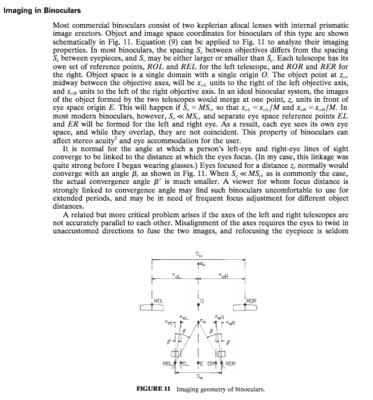
It seems from their research Donald Harry Jacobs published his notes on binoculars and prism misalignment here within this text's 487 pages :
-----------------
Fundamentals of Optical Engineering
jacobs, donald
ISBN x: 0070321507 / ISBN 13: 9780070321502
Published by McGraw-Hill Volume Company, i 1st ed.
Description New York : McGraw-Hill, 1943
10, 487 p. : ill. ; 24 cm.
Notes
An expansion of the author'southward notes for a course in applied eyes given under the Engineering, Science, and Management War Training program at George Washington University.
Includes bibliographical references and indexes.
-------------------------
They note:
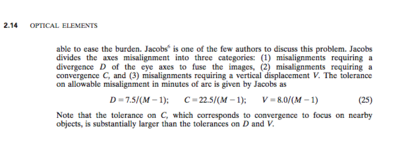
"Jacobs is one of the few authors to talk over this problem ( reference in a higher place).
Jacobs divides the axes misalignment into three categories :
(ane) misalignments requiring a deviation D of the eye axes to fuse the images ,
(2) misalignments requiring a convergence C
(3) misalignments requiring a vertical displacement Five .
The tolerance on allowable misalignment in minutes of arc is given by Jacobs every bit
Divergence: 7 . 5 / ( M - 1) ;
Convergence: 22 . v / ( M - 1) ;
Vertical: 8 . 0 / ( Grand - one) (25)
Note that the tolerance on C , which corresponds to convergence to focus on nearby
objects , is substantially larger than the tolerances on D and V"
No eastward-version of Jacobs' book seems available, he seems to be the scientist who studied this for the war dept, the motorcar that is an Army on state of war basis probably spit out the other number set based on his work.
I found a copy on abbes books and am ordering it, should be here in a week or ii, let you know what I find, information technology is almost 500 pages, might have a petty digging.
I thought the photonics handbook primer comments on visual adaptation as a office of distance were were insightful besides.
Clear Skies
Lou
#22
Posted 15 Dec 2018 - 12:52 PM
Then my opinion, some things as always, especially in physiological studies, are subject to interpretation.
Merits seems to be it is shut to diffraction limited vertical. Perhaps that can be true, experienced observers seem to match that criteria on, for example, 20x 100mm night time observation.
I think in that location is some modern piece of work that can evidence why that is (just) possible.
A)
The human center nether depression light with 5mm iris has a calculated edge diffraction resolution limit of 1.2 10^-4 radians or .4 minutes of arc
Mayhap surprisingly your encephalon and rudimentary optic system can actually get to around 4 10^-4 or 1.5 minutes of arc bending ( 1.5 * 1/lx of a degree).
http://hyperphysics....opt/Raylei.html
http://world wide web.kylesconv...rcminutes#.0004
B)
Austin Roorda, Ph.D.,Academy of Houston College of Optometry, put this deck together online and gave permission for use. It has some peachy points.
http://voi.opt.uh.ed...orda_Optics.ppt
First lets encounter what 1-xv minutes of arc angle looks like projected on to the retina:
Sampling past Foveal Cones
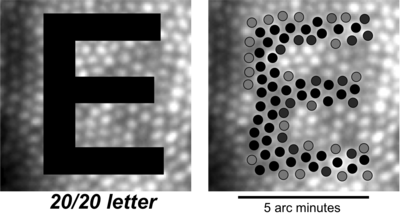
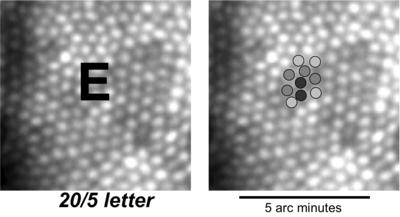
They also brand the point that this photoreceptor array is "sampling" spatially across your retina at a charge per unit of 120 cones per caste or you can detect a two bright points separated by one arc minute, again at the diffraction limit of your perfect eye, or 4 or 5 times better then your actual eye.
Said another way Ed is using four or five photoreceptor cones in each eye for each tiny star he sees with both eyes. Thats non a lot of info, your brain is working pretty hard to reconstruct that image. Perhaps given Jacobs empirical report, Your brain is perhaps using vertical every bit reference, this could explain the observation fatigue.
Daytime use has lot other phenomena including your brain actually "sees" better in brighter calorie-free, and also information technology its interesting to note most people eyes are have the visual axis about four degrees inward, 360 minutes of arc, or in other words looking directly frontward mechanically, your eyes converge on a spot about artillery length away. This probably explains why divergence is awful and convergence is much more tolerated.
and of course none of this matters if your not using a close to diffraction limited optical train and device functioning....
I imagine proving diffraction limited vertical collimation is also a bit tricky.
- MeridianStarGazer likes this
#23
Posted fifteen December 2018 - 01:xvi PM
Haha......right!
Alignment machines might see/feel the tightest limit.....merely people? Not likely.
Information technology is truthful that stars give the cortex less to work with than a grove of trees, of course.
Still, cognitively aligning views with 10-200 stars is not too tough..
#24
Posted 21 Dec 2018 - 07:06 PM
Rich V. sited Claudio:
"Vertical stride: fifteen arc minutes
Divergence: xx arc minutes
Convergence: sixty arc minutes"I found fifty-fifty more discussions past Claudio on various standards here: https://www.cloudyni...ested/?p=323377
I tested my binoculars APM 82 mm 45° ED at 147x with objects distant nine.three miles (15 km). I noted the apparent alignment fault which is 35' horizontal convergence and vertically 14'.
Moving the epitome into the 3.2 mm 60° eyepieces (Tecnosky planetary ED) dist. nine.3 miles:
Horizontal convergence 39.4 inches (1m).
Vertical 15.seven inches (40 cm).
What satisfaction this APM binoculars!!
#25
Posted 31 December 2018 - 06:12 PM
Allignment or collimation are common in binoculars fifty-fifty new ones from
the most well known mfrs.
It was posted above about a collimation test for vertical and horizontal
alignment. I have done that with a flat rest tripod mountain, the easiest to
utilize, retrieve Bogpod or Berlebach.
I have many binoculars and I live in a rural site, and I like a target of
1/ii mile to over a mile away. Route signs, ability poles are very good targets
and are easy to use, I have washed ten binoculars in a short time.
This is all from my living room.
I have some 15-sixteen-20X power binoculars, from several sources, the Nikon Monarch
5 models are a nifty value in this surface area.
The Celestron Skymaster, should include with instructions on how to plow
the screws.!!!! They are easily establish on the internet and needed.
Jerry

Source: https://www.cloudynights.com/topic/642770-limit-for-acceptable-collimation-errors/
Posted by: gonsalvesextres47.blogspot.com
0 Response to "How To Repair Collimation Errors"
Post a Comment